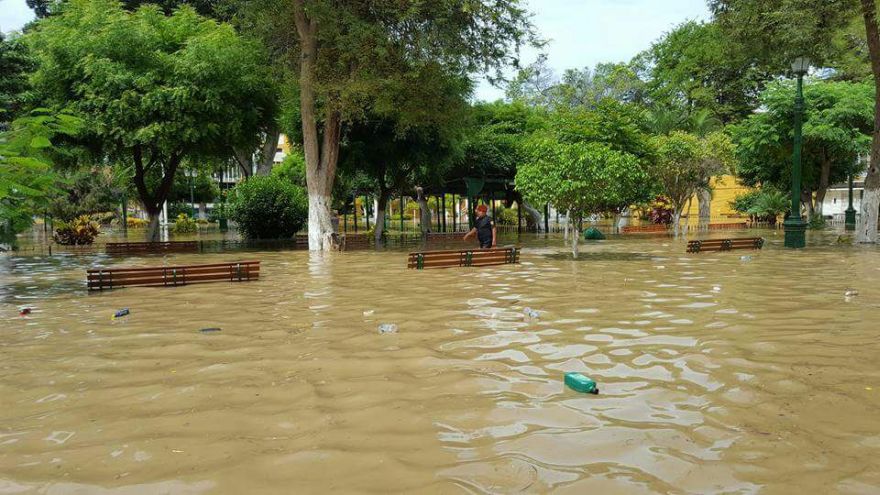
What’s the issue? I visited northern Peru in January, and the weather was uncommonly nice. In Tumbes it was cooler than I remembered for mid-summer, the mosquitos had not yet come out in force, and there was barely any rain. In Piura it was quite hot and one afternoon we were unwittingly caught in a torrential downpour, but still, nothing terrible. Since then the situation has changed dramatically. Extremely heavy rainfall has caused rivers to overflow, bridges to collapse, and mudslides to destroy towns (seriously, take a moment to look at the pictures in those links). According to COEN (Peru’s Center of Operations for Emergency Response), as of March 31st there have been 101 deaths and 141,860 people who have been injured or have lost their homes and/or their livelihoods due to the rains and mudslides.
Why do I care? These rains are a result of a localized El Niño phenomenon that has been dubbed “El Niño costero,” or a coastal El Niño. Basically, the ocean off the coast of Northern Peru and Ecuador is up to 9 degrees warmer than usual, and this warm water is causing increased rainfall (total rainfall for 2017 is ten times the normal average). While El Niño is a well documented phenomenon that has been around since at least the Incan times, there is evidence that climate change is making things worse. We know, for example, that El Niños are becoming stronger and more frequent, most likely as a result of increased carbon dioxide in the air. We also know that warming ocean temperatures are caused in part by greenhouse gases. It’s too early for sure to tell whether climate change can be linked directly to this year’s El Niño costero, but it seems likely. In fact, this event is right in line with what some climate change models predicted would happen as a result of climate change.
Meanwhile, in the United States, Trump and his administration are busy dismantling environmental protections and denying the existence of human caused climate change. The executive order that Trump signed last week will undo Obama’s Clean Power Plan, which aimed to close coal powered plants and replace them with clean energy. Trump has also rolled back fuel and energy efficiency standards since taking office. In 2015, the United States pledged to cut emissions by 26% by 2025. With the executive actions taken against the environment by Trump, the US is now projected produce more emissions in 2025 than we do today.
I connect these two themes because this story is becoming more and more common- poorer and less developed countries are disproportionally bearing the brunt of the harmful effects of climate change, and the poorer and less developed parts of those countries even more so. Thus those who are most affected by climate change are those who have the least amount of say in the US’s environment policies. The flooding in Peru is just one example, one that’s close to my heart, of a catastrophic weather phenomenon in recent years that has caused loss of life and livelihood. It’s up to us to amplify this issue and make sure we are all heard.
What to do if you care too:
- Donate to help rebuild Peru. Partners in Health and CARE are raising money for relief projects in Peru, and several current Peace Corps Volunteers have set-up gofundme sites to help their communities: to provide shelter for those who have lost their homes in Morrope, Lambayeque; to help a host family rebuild their home in Moche, La Libertad; and to help another large host family in the wake of disaster.
- If you can, drive a fuel efficient car (or better yet, no car at all). This article from the New York Times shows that driving a fuel efficient car (that gets at least 56 miles per gallon) does more for the planet than flying less, driving less, turning down your thermostat, and reducing meat consumption combined (of course you can still do those things too!).
- Contact your representatives, and tell them what you think about Trump’s environmental executive actions. To find your representatives and see a sample climate change script for when you call, click here.
- Next time you vote, make sure you vote for representatives who believe in climate change and pledge to take action. You can check out how your current representatives are doing on the League of Conservation Voters’ National Environmental Scorecard.
- Oppose Trump’s proposed budget cuts to important pro-environment and pro-science entities including the Environmental Protection Agency, the Energy Department, and the Nationals Institutes of Health. Again, contact your representatives.
 Persistence
Leave a comment