
What’s the issue? Every week on this blog I talk about a different issue, and outline what we can do to act on that issue and make our voices heard. Almost every week, I recommend contacting your representatives in Congress. But what is the most effective way to contact Congress and does it actually make a difference?
What did I find out? Calling Congress works (if you are a constituent, don’t call someone who doesn’t represent you, it will likely be a waste of your time). Congressional members aren’t required to publish the number of calls they receive or how the calls influence their views, so I don’t have data to prove it, but Congressional staffers (who are the ones actually answering the phones) and Congresspeople themselves say that calling makes a difference. Calling seems to be most effective for one of two reasons: 1) an individual caller (or a small number of callers) calls about an issue that the Congressperson is not familiar with and makes a compelling case or 2) so many people call in as part of a coordinated calling campaign that they are impossible to ignore. When you call Congress your call will most likely be answered by an intern or a low level staffer, but your call and your opinion will most likely also be recorded and passed on (at least in terms of numbers in favor or against) to the Congressperson. I was an intern for Mark Udall when he worked in the House of Representatives, and although it was a decade ago now, this is exactly what I experienced. I picked up the phones and recorded the calls. At the end of the day I gave the call sheet to my supervisor, who consolidated it with others and eventually gave it to the Congressman.
What about other ways of contact Congress? Personal visits are always best, but are not always practical for many people (although don’t forget that you can make an appointment in person at your Congresspeople’s local offices, not just their DC offices). Emails and letters (especially personal ones that are not written in a form template), will also be recorded. Don’t forget that letters will be screened before they make it to your Congressional offices, so they make some time to arrive. Online petitions, facebook comments, and tweets likely won’t make a difference (unless they gain a lot of attention).
So, without further ado…
How to call Congress:
- Find your representatives and get their numbers. If you live in one of the 50 recognized states, you have three representatives- two Senators who represent your whole state, and one Congressperson who represents your more local district. You can find your representatives and their contact information here.
- Decide what you want to say. Pick one issue at a time. Are you calling to give your opinion on a specific issue? To urge your Congressperson to vote a specific way on a bill? To find out your Congressperson’s views on an issue? Think about what you want to say ahead of time so you can make your point clearly. If you are referencing a specific bill, make sure to have the bill number ready. You can find some useful scripts for calling about various issues here, here, and here, but if you can it’s a great idea to make your call personal.
- Call. Make sure to give your name and zip code to prove you are a constituent, be clear and concise, and most of all be nice (don’t forget to say thank you).
Tips to make you even more effective:
- Ask for a follow-up to your call. This makes it more likely that your call and opinion will be recorded.
- Stick to one issue at a time. Many Congressional offices record each call as one issue, regardless of how long or complex the conversation. If you want to talk about more than one issue, call back.
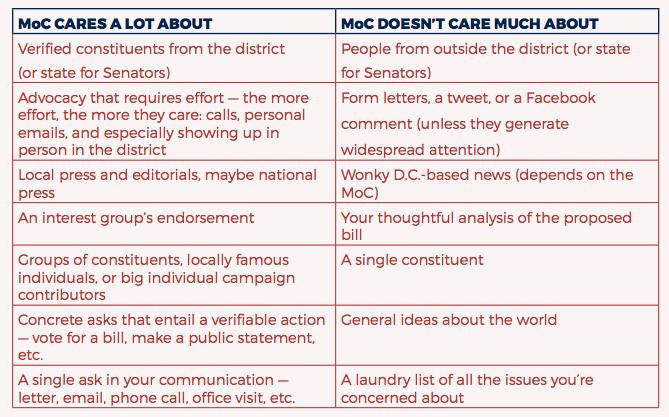
- Highlight things your representative cares about. Below is a screenshot from The Indivisible Guide, with some excellent tips on how to get your Member of Congress’s (MoC’s) attention:
- Build a relationship with the staffers in your representatives’ offices. Stop by to visit if you can. Thank them on social media or with an op ed piece when they do something you like. Call often.
- Be a resource in your area of expertise. Offer to share useful information with staffers. Invite them on a “field trip” to see your work or your community. If they know you and your work they’re more likely to reach out to you for advice.
Useful resources:
- 5calls– This website, also available as an app, makes it super easy to contact your representatives. You just enter your zip code and pick an issue and 5calls will give the the name and number for your representative as well as a sample script you can use. Once you’ve made the call you can advance to your next representative with just a click.
- The Indivisible Guide– This excellent guide is all about harnessing the tactics of the Tea Party (minus the hate and false information) to resist the Trump agenda. They have great information on calling, town halls, visiting your Congressperson, and more.
- Make Me Call– If you really want to make contacting your representatives effortless, sign up for makemecall.org. You will get a call from them every day, and when you pick up you’ll be connected to one of your representatives. Easy as that.
Special thanks to Rebecca Farley and the anonymous others I talked to for their help with this post.
Cover photo by Clark from Flickr.
 Persistence
Sarah–glad to read this as I’ve been slothful about making calls for the past couple of weeks. One of my senators, Tammy Baldwin and my representative, Mark Pocan are aligned with my views so I only call them about once a week to say thank you. The other senator is a tea party conservative, Ron Johnson so I call even with the feeling that it doesn’t do a thing. I also call the Speaker of the House, ashamed that lyin’ Ryan is from Wisconsin. What do you know about the movement to send faxes to congressional offices? I know people who are doing it through an app called Resistbot but I am dubious.
Sarita
LikeLike