
What’s the issue? May 25, 2017 marked 10 years since the federal government has increased the minimum wage, which is currently $7.25 per hour. Democrats introduced the Raise the Wage Act, which would raise the minimum wage to $15 by 2024. State minimum wages vary between $5.15 (Georgia and Wyoming) and $12.50 (Washington DC) per hour (although employers must comply with both, so in practice the least non-tipped employees should be making is $7.25 an hour). Some cities also set a minimum wage. The highest of these include Seattle and DC, which are gradually phasing-in minimum wage increases to $15 an hour.
Why do I care? The minimum wage is unquestionably too little to live on in the United States. A person working full-time for $7.25 an hour would make just $15,080 a year, before tax (according to this tax calculator take-home pay would be below $14,000). This is far below the federal poverty line for a family of four, which is $24,600. Nowhere in the United States can a person working full-time for the federal minimum wage afford to rent a two-bedroom apartment. (The Department of Housing and Urban Development defines affordable housing as spending less than 30% of your income). Even to rent a one-bedroom, $7.25 an hour is only adequate for 12 counties. This map shows how much you have to make in each state to afford to rent a two-bedroom apartment. The map below (made by me using data from here and here) shows the gap between how much you need to make and the current minimum wage. The gap ranges from $5.22 more needed per hour (Arkansas) to $25.95 more needed (Hawaii). Here you can see that while DC has the highest minimum wage (looking at states), it still needs to be $22.08 higher for affordable housing.
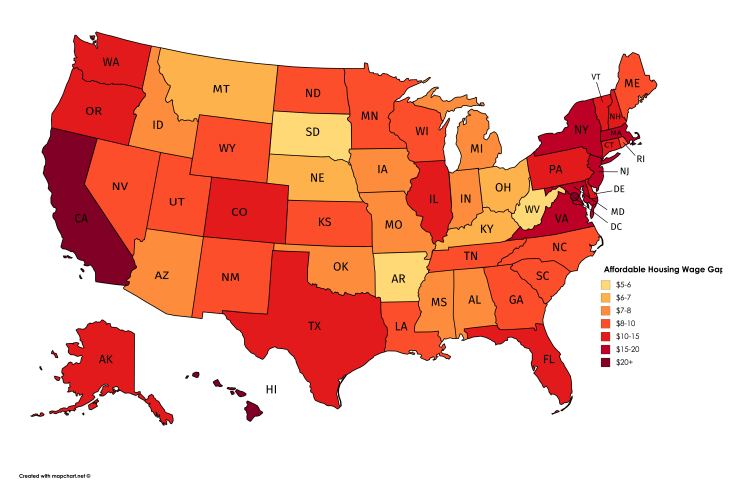
Even raising the federal minimum wage to $15 an hour would only be enough for workers to be able to rent a 2-bedroom apartment in 14 states, but it would at least put a family of four over the poverty line.
It’s clear that the minimum wage is too low. Even if it had just kept pace with inflation it would be $10 today. Many economists have studied what effect the minimum wage has on the economy, and a review of the studies finds that there is almost no discernible effect on employment. Large minimum wage increases have not been studied widely, but a study of Seattle’s recent increases shows a way forward is possible. Even 61% of small business owners, who some say a minimum wage increase would hurt, support raising the minimum wage. I refuse to believe it’s not possible for us to live in a country where you can afford a two-bedroom apartment if you work full time.
What you can do if you care too:
- Call your Congresspeople and tell them you support the Raise the Wage of 2017 Act (S.1150 in the Senate and H.R.15 in the House). This is most likely a nonstarter in this Congress, but it’s always good to show support.
- In the meantime, lobby your local representatives to raise your state, city, or county’s minimum wage.
- Elect officials who support increasing the minimum wage (make sure you check out their position on minimum wage before you vote, and if they don’t have one, ask them for it). This is the only way forward for raising the federal minimum wage.
- Sign-up for alerts on upcoming strikes and protests from Fight for $15.
- Shop at business that pay their employees a higher wage and support a minimum wage increase (check their website to see if they have a position). If a minimum wage increase is passed where you live, make a special effort to shop at small businesses that may have a harder time absorbing the increase.
 Persistence
Leave a comment